
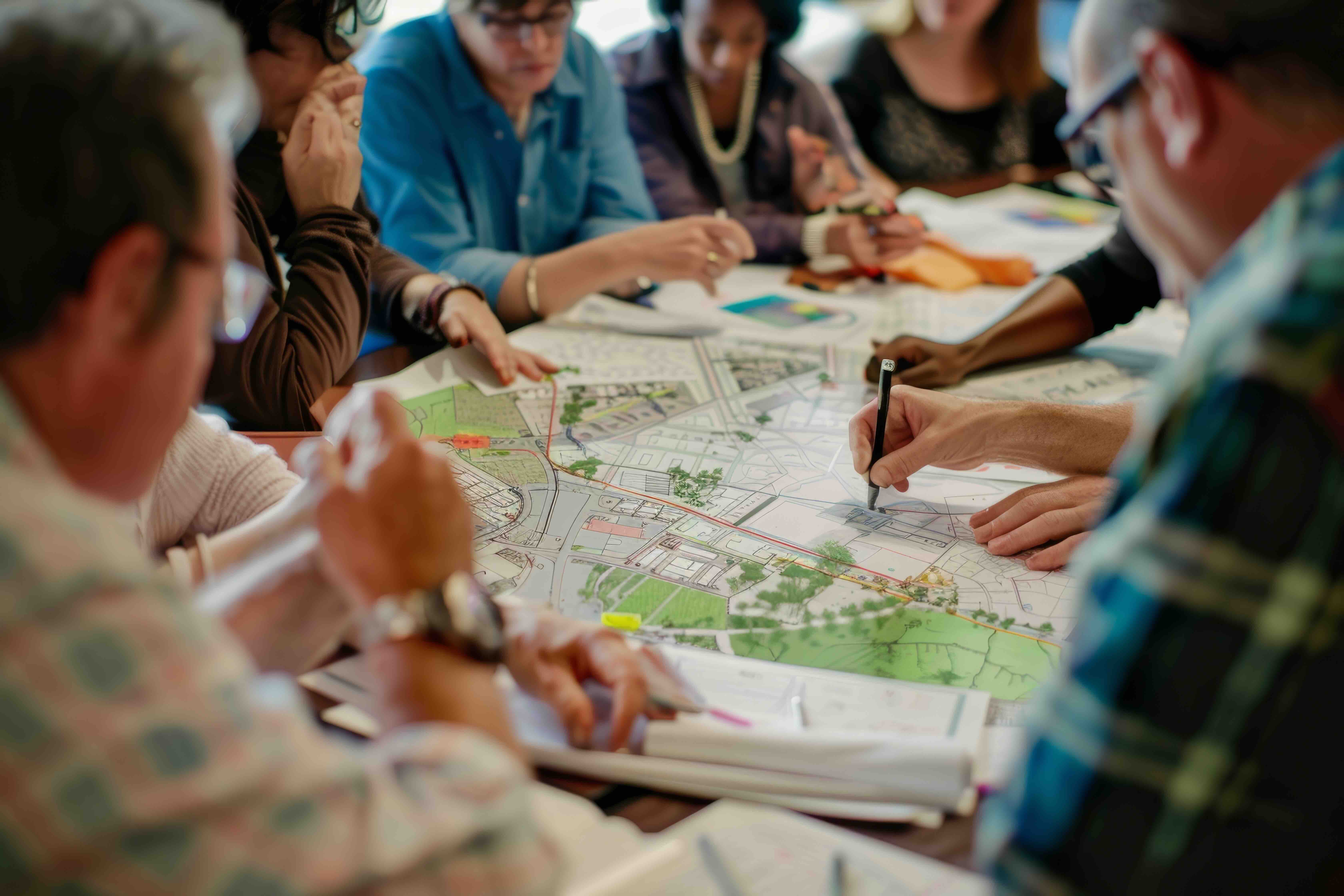
The meeting invitation promises dialogue. Interactive discussion. A chance for everyone to weigh in on the new strategic direction.
Sixety minutes later, the same three people have dominated the conversation. Again. The program manager who always has an opinion. The board member who needs to process out loud. The consultant who was hired specifically to guide the discussion.
Everyone else sat quietly, nodding occasionally, maybe typing notes. When the facilitator asked "Does anyone else have thoughts?" there was the familiar uncomfortable silence, followed by a quick move to the next agenda item.
The meeting ends. The organizers feel good. "Great engagement today," someone says.
But what actually happened? What decisions were shaped by voices that were never heard?
Here is what most organizations get wrong about inclusive design: they think it is about inviting people to the table. But you can have every stakeholder in the room and still build a strategy that reflects only a fraction of the perspectives present. Inclusion is not about who shows up. It is about whose voice shapes decisions.
Research from MIT found that in most meetings, just three people contribute 70% of the conversation. This is not because everyone else has nothing to say. It is because most meetings are not designed for inclusion. They are designed for efficiency, for those who are comfortable speaking up, for people who already have power. When we do not actively design for inclusion, we default to exclusion. We mistake attendance for participation, confuse silence for agreement, and build strategy on a narrow foundation while wondering why it does not hold.
Inclusive design is more than adding diverse voices to a planning committee. It is a commitment to building equitable, accessible decision-making processes that genuinely share power. This means going beyond the surface and asking not just "Who is in the room?" but "Whose perspective is shaping our understanding of the problem?" Not just "Did we hear from everyone?" but "Did we create conditions where everyone felt able to contribute their truth?" Not just "Are we considering diverse viewpoints?" but "Are we willing to change our plans based on what we hear?"
The difference between tokenism and genuine inclusion is power. Tokenism invites people to witness decisions. Inclusion invites them to shape those decisions, even when it makes the process messier, slower, or more challenging.
If you want to know whether your strategy process is truly inclusive, ask yourself these questions. Whose voice is shaping your decisions? Not whose voice did you hear, but whose voice actually influenced what you decided. There is a difference between listening and being moved by what you hear.
Whose voice is missing, and why? This is the harder question. Sometimes people are not in the room because they were not invited. Sometimes they are not in the room because they have learned their input does not matter. Sometimes they are in the room but not speaking because the conditions do not feel safe or welcoming. The why matters as much as the who.
What question can you ask to invite broader participation? Inclusive design is not passive. It requires actively creating space for voices that would otherwise go unheard. Sometimes that is as simple as "What are we missing?" Sometimes it requires a more specific invitation: "For those of you working directly with community members, what are you seeing that we might not understand from here?"
These questions are uncomfortable because they require admitting that your current process might be excluding people unintentionally. They force you to confront power dynamics you might prefer not to name. They slow you down when you are already feeling behind. But they are also the only way to build a strategy that actually reflects the complexity of the communities and systems you are trying to change.
Inclusive design is not about running better meetings, though that is part of it. It is about fundamentally rethinking how decisions get made. This requires making power visible. Most organizations operate with invisible hierarchies where the executive director's opinion carries more weight than the program coordinator's, even when the program coordinator has more direct experience with the issue at hand. The long-tenured board member's perspective shapes decisions more than the newest community representative's, even when the community representative brings the lived experience everyone claims to value. Inclusive design means naming these dynamics explicitly and creating structures that intentionally redistribute influence.
It requires designing for accessibility. Not just physical accessibility, though that matters, but cognitive accessibility in how information is presented and processed. Linguistic accessibility, whether people can participate in their first language or communication style. Cultural accessibility, whether the norms of engagement honor different ways of showing up and contributing. When you only design for one way of participating, you only get input from people who are comfortable with that style.
It requires co-ownership. The difference between consulting people and co-creating with them is ownership. Consultation says "We will ask for your input and then decide." Co-creation says "We will figure this out together, and the solution will be different because of your involvement." Co-ownership means people do not just implement your strategy but help shape it, refine it, and own it as theirs.
It requires time and trust. You cannot rush inclusive design. Building the trust necessary for people to share honestly, especially when power dynamics are at play, takes time. Creating the conditions for meaningful co-creation takes patience. Sitting with disagreement and complexity rather than rushing to consensus takes discipline. This is hard in a sector that constantly pushes for faster results, clearer metrics, and more efficient processes. But the alternative, building strategy that looks good on paper but fails in practice because it was never truly inclusive, is harder.
Pay attention to your meetings, not just the big strategic planning sessions, but every meeting where decisions get made. Notice who speaks first, who speaks most, whose ideas get built on versus whose get politely acknowledged and moved past. Notice who gets interrupted, who gets asked clarifying questions that help refine their thinking versus who gets questions that feel like challenges.
Notice who is literally at the table versus on the video screen, who is in the room versus dialing in, who has access to pre-meeting materials and context versus who is hearing things for the first time. Notice what happens when someone raises a concern or offers a perspective that complicates the plan. Does the group lean in with curiosity or subtly signal that this is not the time for that conversation?
These patterns reveal your actual commitment to inclusion, regardless of what your values statement says. Studies show that diverse teams make better decisions, but diversity alone is not enough. You also need the conditions that allow diverse perspectives to actually influence outcomes. Most organizations have the diversity. What they are missing is the design.
There is a gap between wanting to be inclusive and actually being inclusive. That gap is filled with unexamined habits, invisible power dynamics, and processes that were never designed with equity in mind. Closing that gap requires moving from intention to tangible action.
It means not just inviting people to meetings but redesigning how those meetings work so that participation is genuinely accessible to different communication styles, different levels of comfort with dominant culture norms, and different relationships to formal authority. It means not just asking for input but creating mechanisms to ensure that input shapes decisions in transparent ways, so people can see how their contribution mattered or, if it did not, why not.
It means not just talking about power but redistributing it. Rotating who facilitates meetings. Changing who gets to make final calls. Experimenting with decision-making processes that do not default to whoever is loudest or most senior. Inclusive design shines a light on the systemic barriers that keep certain voices marginalized. It makes visible what we would rather not see, and then it invites us to build something different.
Imagine a strategy that is not just informed by the people it affects but genuinely co-created with them. Where the frontline staff who implement programs have real influence over program design, not just feedback opportunities after decisions are already made. Where community members are not consulted but are co-designers, shaping priorities and success metrics based on what actually matters in their lives. Where board governance is not about a small group making decisions for others but about building systems where power and responsibility are genuinely shared.
This is not theoretical. We have seen it work. We have watched organizations transform when they commit to inclusive design, not as an add-on but as a fundamental approach to strategy. It takes longer and it is messier. There is more disagreement, more complexity, more time spent in uncomfortable conversations about power and equity.
But the strategies that emerge are stronger. They are more grounded in reality. They have broader buy-in not because people were persuaded but because they helped build them. They are more resilient because they account for perspectives and barriers that a small planning team would never have seen on their own. And they foster a sense of belonging and co-ownership that is critical for sustained impact. Because when people have genuine power to shape something, they are invested in making it work.
Inclusive design is not a workshop or a one-time initiative. It is a practice, a way of approaching every decision with the question: Whose voice needs to shape this, and have we created the conditions for them to genuinely influence the outcome? It is the third principle of Humanized Strategy, and it transforms how strategy gets built.
Not strategy for people, but strategy with people. Not consulting stakeholders, but co-creating with partners. Not inviting voices to the table, but redesigning the table so that more voices can shape what is built. This is a strategy that reflects everyone it touches, not just in words, but in the decisions themselves.
Stay connected. Get fresh perspectives on Humanized Strategy and social impact, straight to your inbox.

%201%20(1).svg)